Build a balanced full-body week
Combine complementary movement patterns with realistic recovery space.
3 PDF pages · Editable workbook included · No account requiredYou’re viewing the original PDF pages. Read here, then download or print when you’re ready.
THE STRONG TABLE / FREE RESOURCE COLLECTION / SEPTEMBER 2026
1
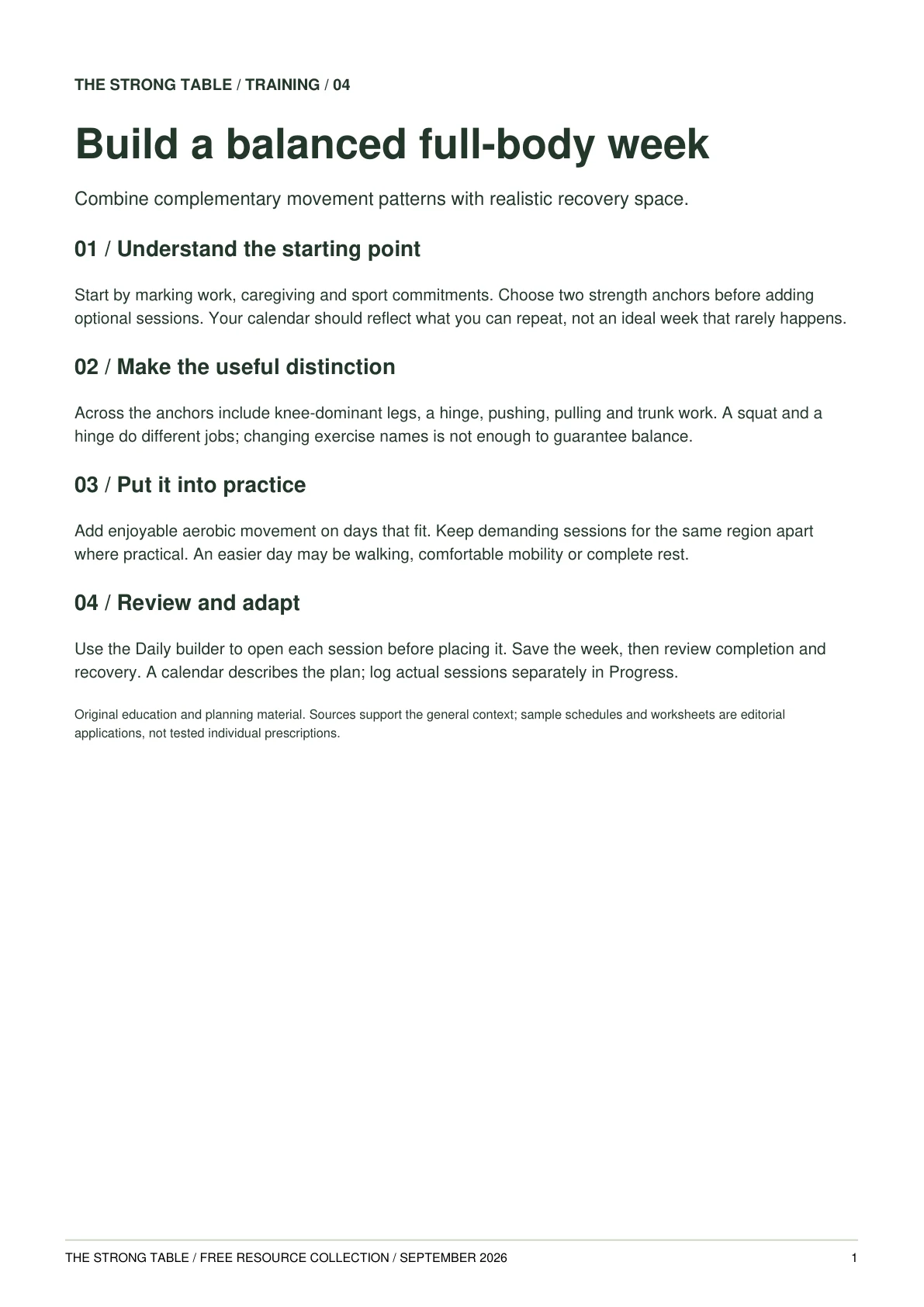
THE STRONG TABLE / TRAINING / 04
Build a balanced full-body week
Combine complementary movement patterns with realistic recovery space.
01 / Understand the starting point
Start by marking work, caregiving and sport commitments. Choose two strength anchors before adding
optional sessions. Your calendar should reflect what you can repeat, not an ideal week that rarely happens.
02 / Make the useful distinction
Across the anchors include knee-dominant legs, a hinge, pushing, pulling and trunk work. A squat and a
hinge do different jobs; changing exercise names is not enough to guarantee balance.
03 / Put it into practice
Add enjoyable aerobic movement on days that fit. Keep demanding sessions for the same region apart
where practical. An easier day may be walking, comfortable mobility or complete rest.
04 / Review and adapt
Use the Daily builder to open each session before placing it. Save the week, then review completion and
recovery. A calendar describes the plan; log actual sessions separately in Progress.
Original education and planning material. Sources support the general context; sample schedules and worksheets are editorial
applications, not tested individual prescriptions.
THE STRONG TABLE / FREE RESOURCE COLLECTION / SEPTEMBER 2026
2
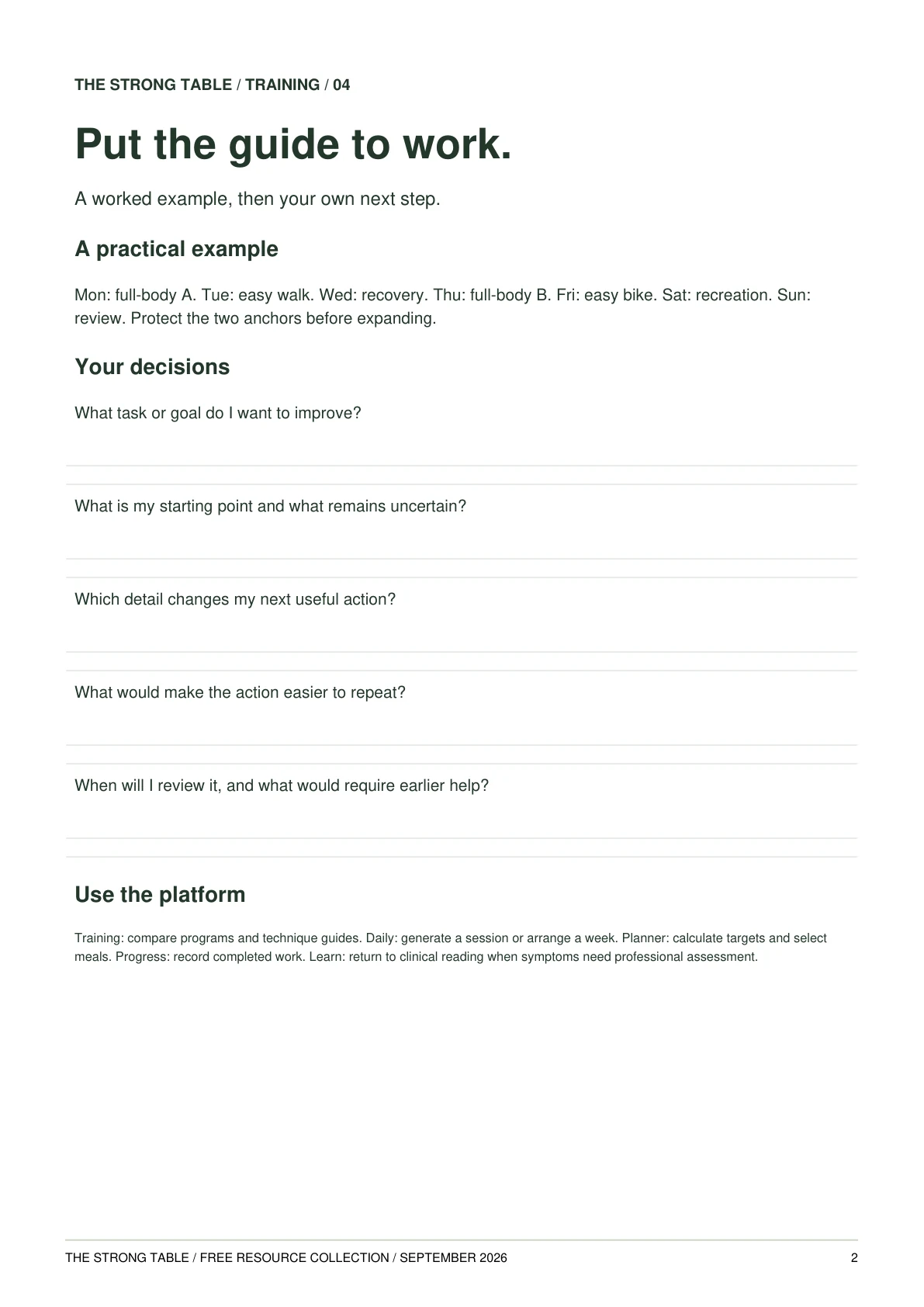
THE STRONG TABLE / TRAINING / 04
Put the guide to work.
A worked example, then your own next step.
A practical example
Mon: full-body A. Tue: easy walk. Wed: recovery. Thu: full-body B. Fri: easy bike. Sat: recreation. Sun:
review. Protect the two anchors before expanding.
Your decisions
What task or goal do I want to improve?
What is my starting point and what remains uncertain?
Which detail changes my next useful action?
What would make the action easier to repeat?
When will I review it, and what would require earlier help?
Use the platform
Training: compare programs and technique guides. Daily: generate a session or arrange a week. Planner: calculate targets and select
meals. Progress: record completed work. Learn: return to clinical reading when symptoms need professional assessment.
THE STRONG TABLE / FREE RESOURCE COLLECTION / SEPTEMBER 2026
3
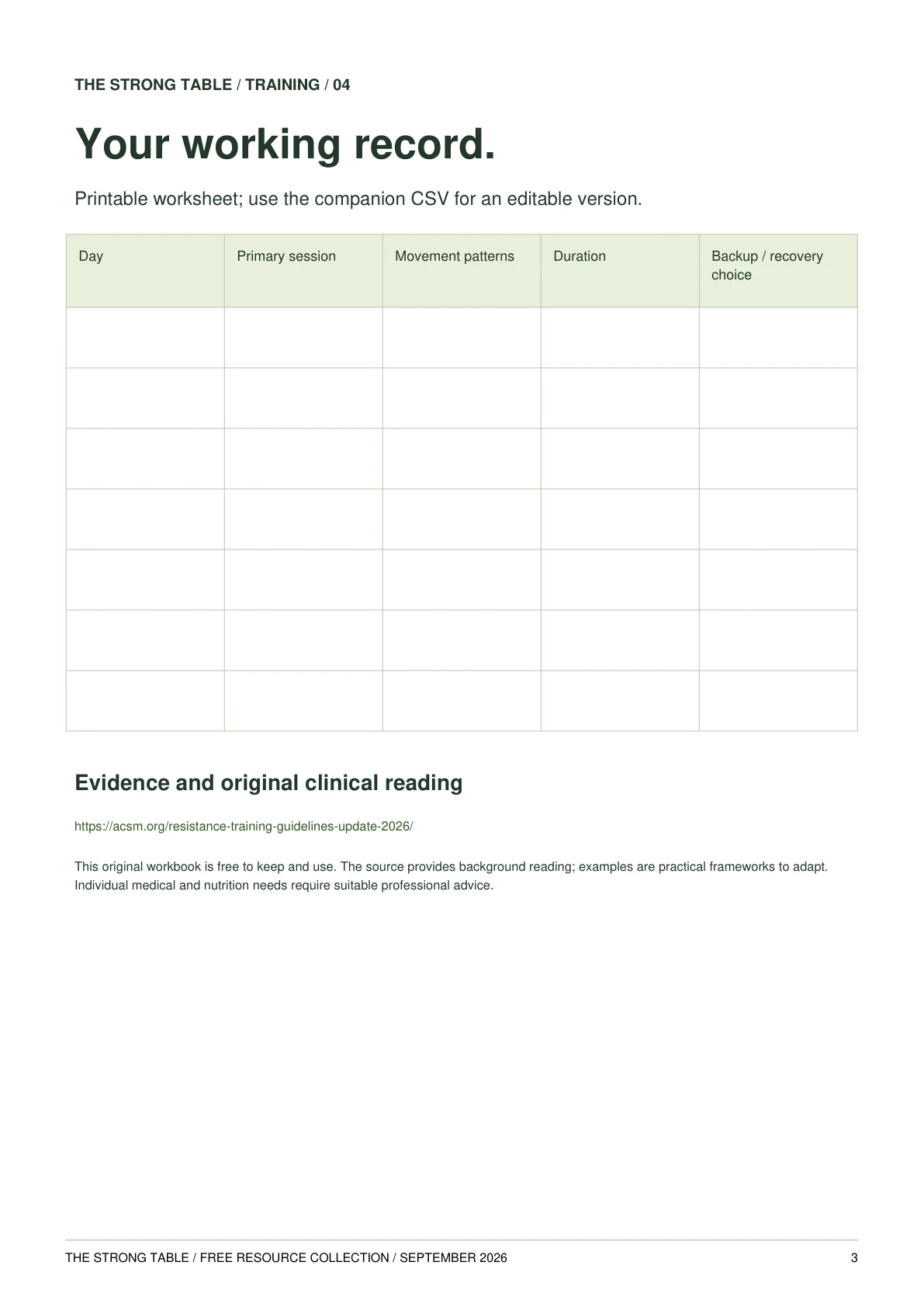
THE STRONG TABLE / TRAINING / 04
Your working record.
Printable worksheet; use the companion CSV for an editable version.
Day
Primary session
Movement patterns
Duration
Backup / recovery
choice
Evidence and original clinical reading
https://acsm.org/resistance-training-guidelines-update-2026/
This original workbook is free to keep and use. The source provides background reading; examples are practical frameworks to adapt.
Individual medical and nutrition needs require suitable professional advice.
Click any cell to edit. Download the CSV to keep your changes or open it in Excel, Numbers or Google Sheets. Edits stay in this open page and are cleared when you leave. When you download, this website formats your file without saving the contents.
Preparing your editable workbook…
| Row | Day | Primary session | Movement patterns | Duration | Backup / recovery choice |
|---|---|---|---|---|---|
| 1 | |||||
| 2 | |||||
| 3 | |||||
| 4 | |||||
| 5 | |||||
| 6 | |||||
| 7 | |||||
| 8 | |||||
| 9 | |||||
| 10 | |||||
| 11 | |||||
| 12 | |||||
| 13 | |||||
| 14 |