Home training equipment audit
Match each movement to the equipment and space you actually have.
3 PDF pages · Editable workbook included · No account requiredYou’re viewing the original PDF pages. Read here, then download or print when you’re ready.
THE STRONG TABLE / FREE RESOURCE COLLECTION / SEPTEMBER 2026
1
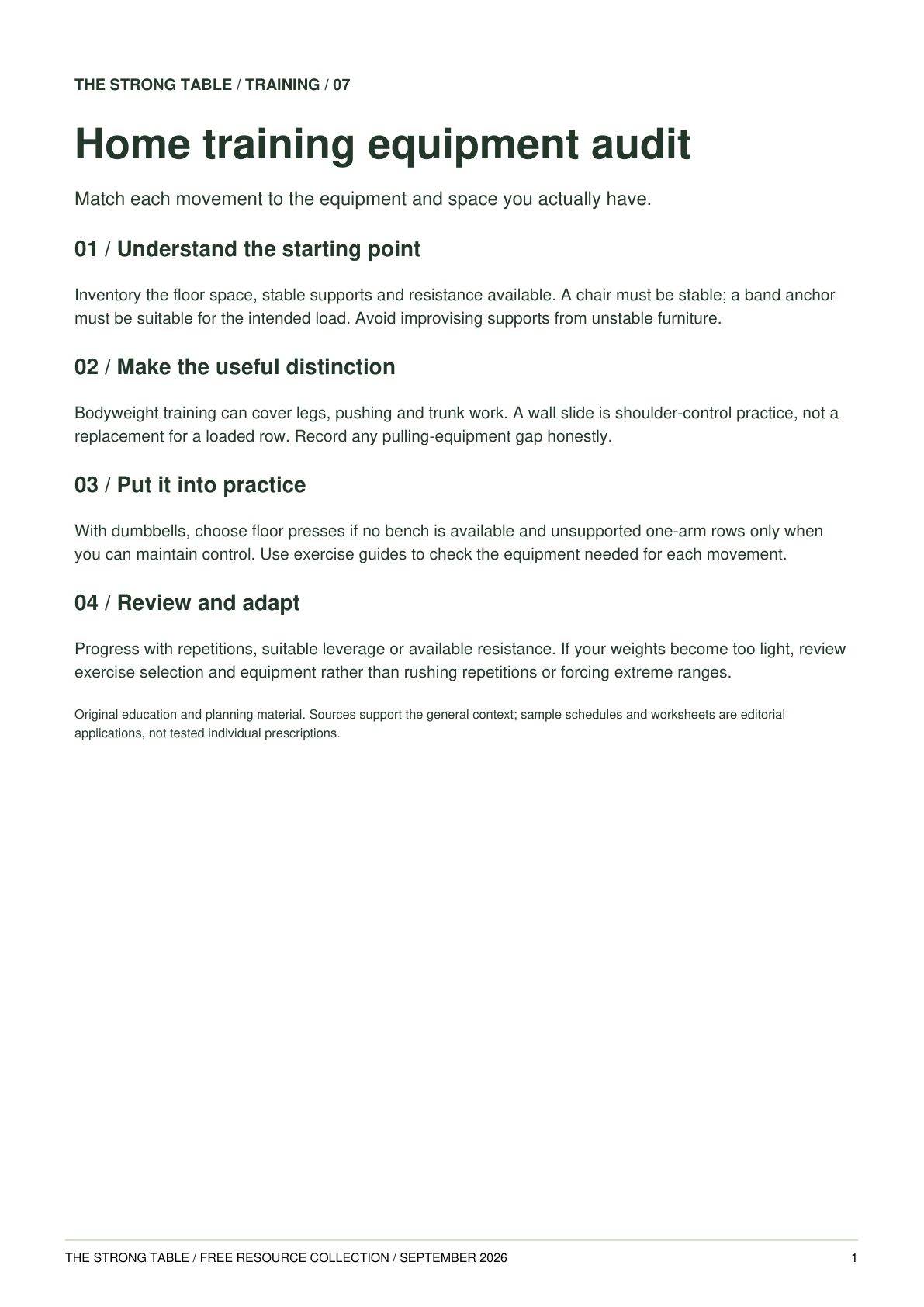
THE STRONG TABLE / TRAINING / 07
Home training equipment audit
Match each movement to the equipment and space you actually have.
01 / Understand the starting point
Inventory the floor space, stable supports and resistance available. A chair must be stable; a band anchor
must be suitable for the intended load. Avoid improvising supports from unstable furniture.
02 / Make the useful distinction
Bodyweight training can cover legs, pushing and trunk work. A wall slide is shoulder-control practice, not a
replacement for a loaded row. Record any pulling-equipment gap honestly.
03 / Put it into practice
With dumbbells, choose floor presses if no bench is available and unsupported one-arm rows only when
you can maintain control. Use exercise guides to check the equipment needed for each movement.
04 / Review and adapt
Progress with repetitions, suitable leverage or available resistance. If your weights become too light, review
exercise selection and equipment rather than rushing repetitions or forcing extreme ranges.
Original education and planning material. Sources support the general context; sample schedules and worksheets are editorial
applications, not tested individual prescriptions.
THE STRONG TABLE / FREE RESOURCE COLLECTION / SEPTEMBER 2026
2
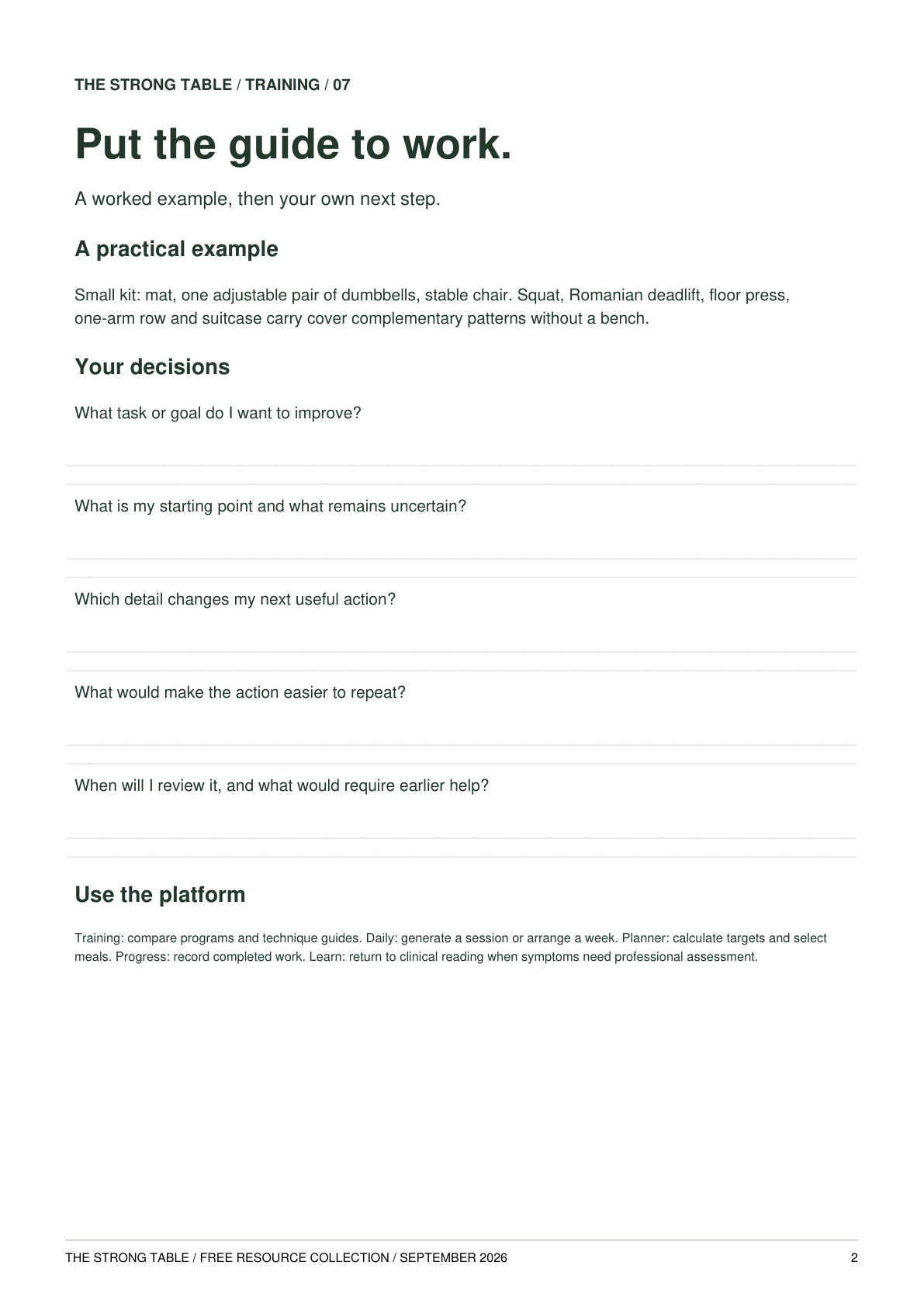
THE STRONG TABLE / TRAINING / 07
Put the guide to work.
A worked example, then your own next step.
A practical example
Small kit: mat, one adjustable pair of dumbbells, stable chair. Squat, Romanian deadlift, floor press,
one-arm row and suitcase carry cover complementary patterns without a bench.
Your decisions
What task or goal do I want to improve?
What is my starting point and what remains uncertain?
Which detail changes my next useful action?
What would make the action easier to repeat?
When will I review it, and what would require earlier help?
Use the platform
Training: compare programs and technique guides. Daily: generate a session or arrange a week. Planner: calculate targets and select
meals. Progress: record completed work. Learn: return to clinical reading when symptoms need professional assessment.
THE STRONG TABLE / FREE RESOURCE COLLECTION / SEPTEMBER 2026
3
THE STRONG TABLE / TRAINING / 07
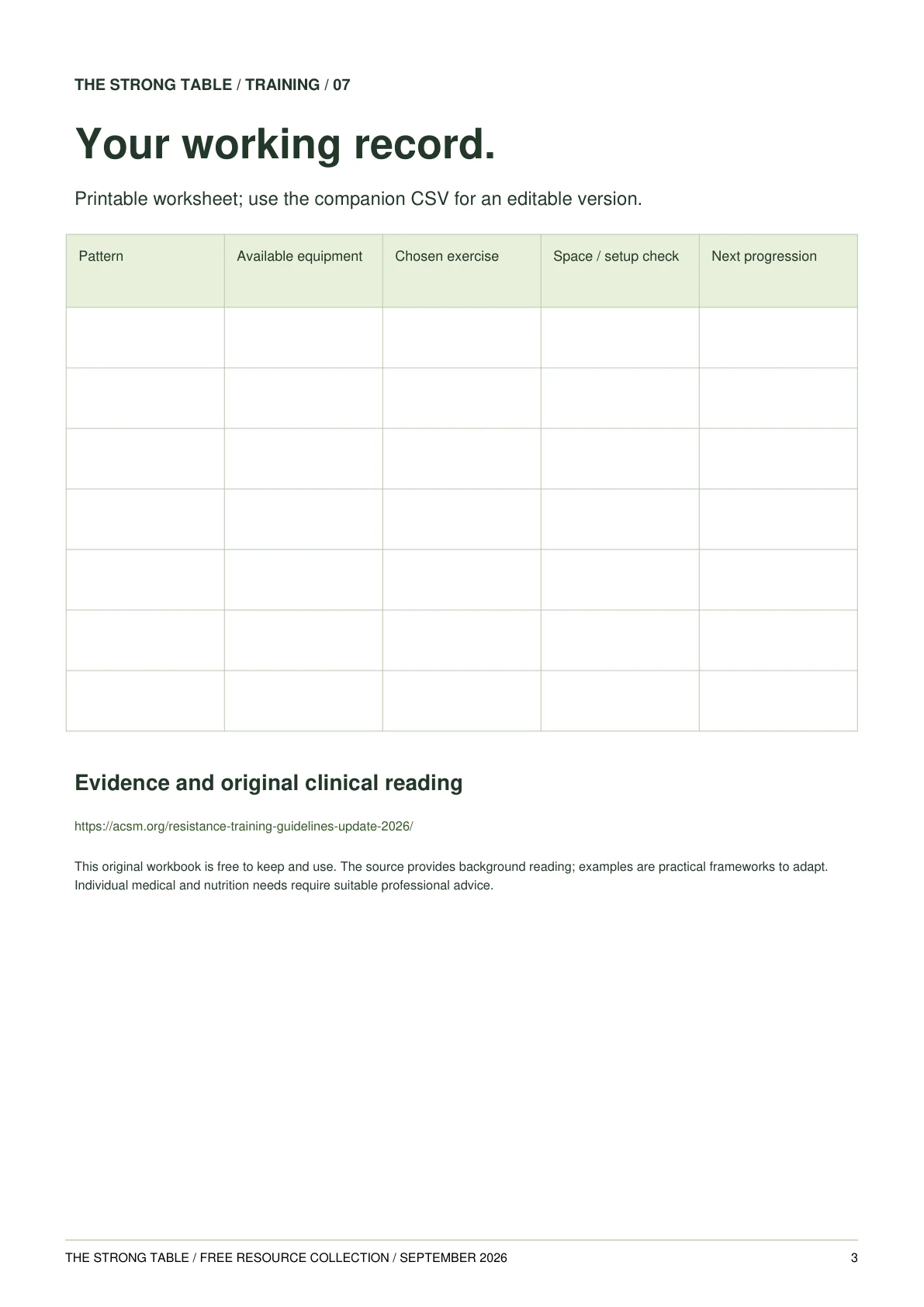
Your working record.
Printable worksheet; use the companion CSV for an editable version.
Pattern
Available equipment
Chosen exercise
Space / setup check
Next progression
Evidence and original clinical reading
https://acsm.org/resistance-training-guidelines-update-2026/
This original workbook is free to keep and use. The source provides background reading; examples are practical frameworks to adapt.
Individual medical and nutrition needs require suitable professional advice.
Click any cell to edit. Download the CSV to keep your changes or open it in Excel, Numbers or Google Sheets. Edits stay in this open page and are cleared when you leave. When you download, this website formats your file without saving the contents.
Preparing your editable workbook…
| Row | Pattern | Available equipment | Chosen exercise | Space / setup check | Next progression |
|---|---|---|---|---|---|
| 1 | |||||
| 2 | |||||
| 3 | |||||
| 4 | |||||
| 5 | |||||
| 6 | |||||
| 7 | |||||
| 8 | |||||
| 9 | |||||
| 10 | |||||
| 11 | |||||
| 12 | |||||
| 13 | |||||
| 14 |