Shoulder, arm & thoracic outlet - education & notes
Clinical-source reading and an observation workbook for neck & shoulder.
3 PDF pages · Editable workbook included · No account requiredYou’re viewing the original PDF pages. Read here, then download or print when you’re ready.
THE STRONG TABLE / FREE RESOURCE COLLECTION / SEPTEMBER 2026
1
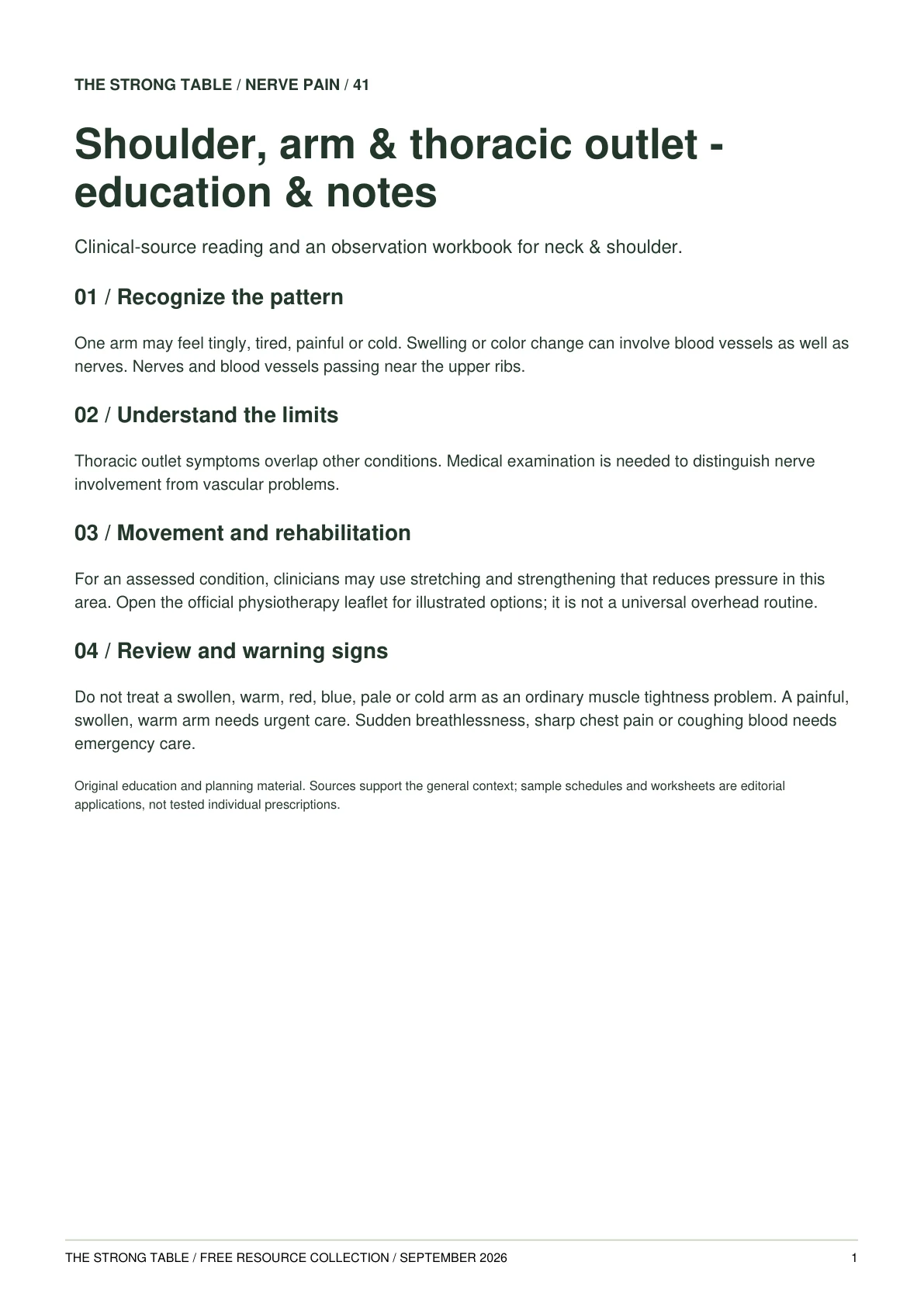
THE STRONG TABLE / NERVE PAIN / 41
Shoulder, arm & thoracic outlet -
education & notes
Clinical-source reading and an observation workbook for neck & shoulder.
01 / Recognize the pattern
One arm may feel tingly, tired, painful or cold. Swelling or color change can involve blood vessels as well as
nerves. Nerves and blood vessels passing near the upper ribs.
02 / Understand the limits
Thoracic outlet symptoms overlap other conditions. Medical examination is needed to distinguish nerve
involvement from vascular problems.
03 / Movement and rehabilitation
For an assessed condition, clinicians may use stretching and strengthening that reduces pressure in this
area. Open the official physiotherapy leaflet for illustrated options; it is not a universal overhead routine.
04 / Review and warning signs
Do not treat a swollen, warm, red, blue, pale or cold arm as an ordinary muscle tightness problem. A painful,
swollen, warm arm needs urgent care. Sudden breathlessness, sharp chest pain or coughing blood needs
emergency care.
Original education and planning material. Sources support the general context; sample schedules and worksheets are editorial
applications, not tested individual prescriptions.
THE STRONG TABLE / FREE RESOURCE COLLECTION / SEPTEMBER 2026
2
THE STRONG TABLE / NERVE PAIN / 41
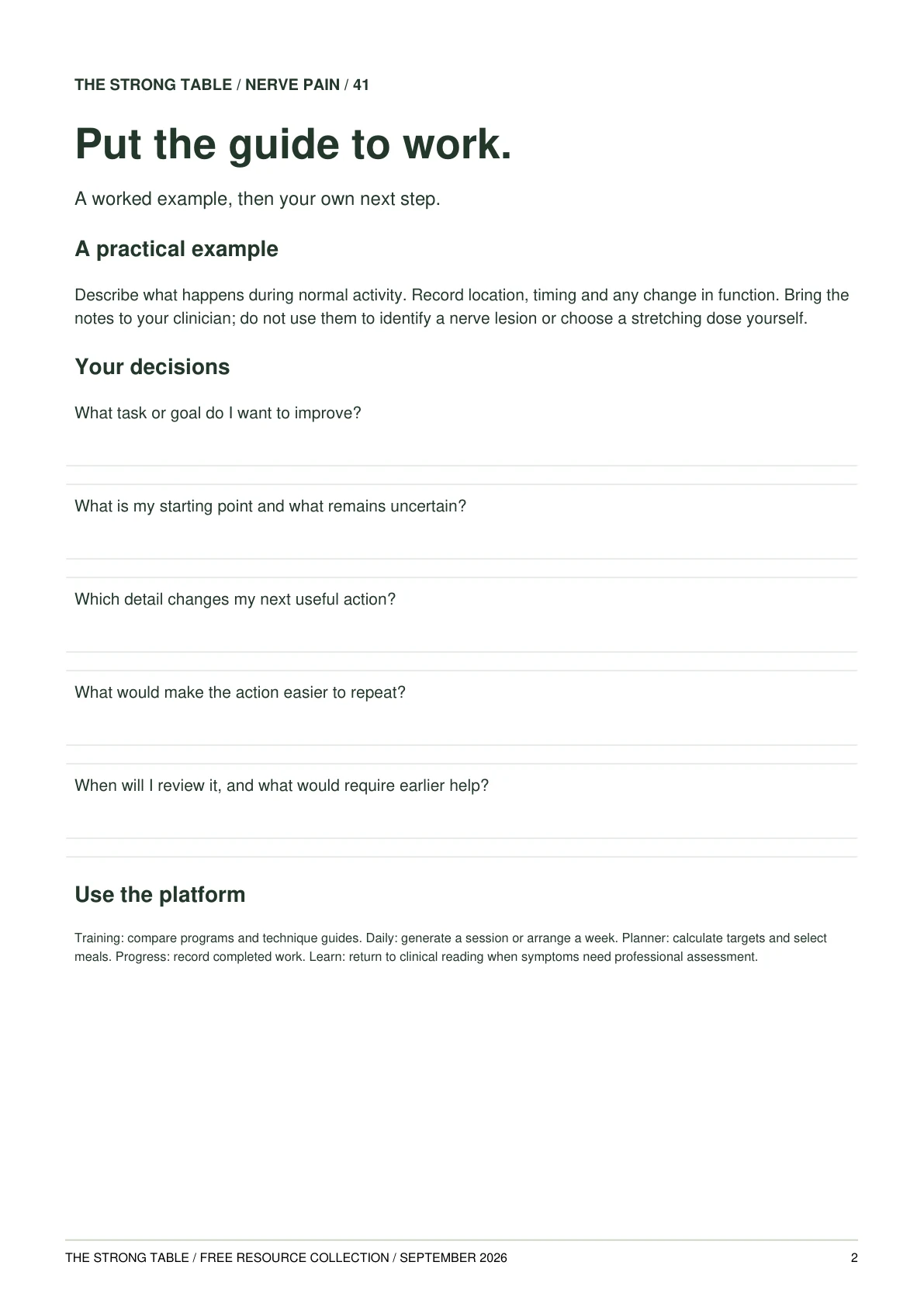
Put the guide to work.
A worked example, then your own next step.
A practical example
Describe what happens during normal activity. Record location, timing and any change in function. Bring the
notes to your clinician; do not use them to identify a nerve lesion or choose a stretching dose yourself.
Your decisions
What task or goal do I want to improve?
What is my starting point and what remains uncertain?
Which detail changes my next useful action?
What would make the action easier to repeat?
When will I review it, and what would require earlier help?
Use the platform
Training: compare programs and technique guides. Daily: generate a session or arrange a week. Planner: calculate targets and select
meals. Progress: record completed work. Learn: return to clinical reading when symptoms need professional assessment.
THE STRONG TABLE / FREE RESOURCE COLLECTION / SEPTEMBER 2026
3
THE STRONG TABLE / NERVE PAIN / 41
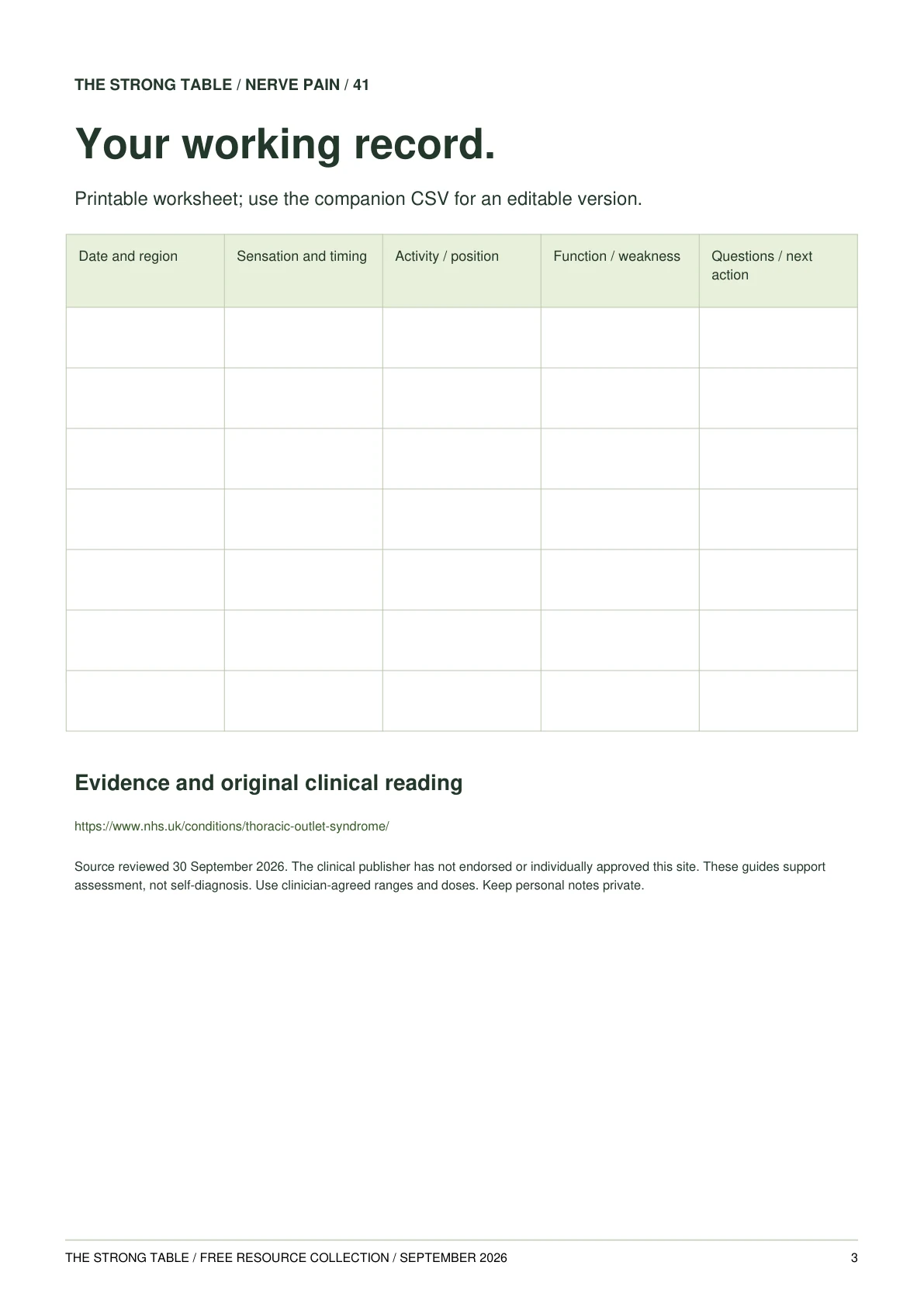
Your working record.
Printable worksheet; use the companion CSV for an editable version.
Date and region
Sensation and timing
Activity / position
Function / weakness
Questions / next
action
Evidence and original clinical reading
https://www.nhs.uk/conditions/thoracic-outlet-syndrome/
Source reviewed 30 September 2026. The clinical publisher has not endorsed or individually approved this site. These guides support
assessment, not self-diagnosis. Use clinician-agreed ranges and doses. Keep personal notes private.
Click any cell to edit. Download the CSV to keep your changes or open it in Excel, Numbers or Google Sheets. Edits stay in this open page and are cleared when you leave. When you download, this website formats your file without saving the contents.
Preparing your editable workbook…
| Row | Date and region | Sensation and timing | Activity / position | Function / weakness | Questions / next action |
|---|---|---|---|---|---|
| 1 | |||||
| 2 | |||||
| 3 | |||||
| 4 | |||||
| 5 | |||||
| 6 | |||||
| 7 | |||||
| 8 | |||||
| 9 | |||||
| 10 | |||||
| 11 | |||||
| 12 | |||||
| 13 | |||||
| 14 |