Dieting / FROM THE EDITOR
Losing fat while giving muscle a reason to stay
The strongest plan combines an appropriate deficit, resistance training, enough protein and room to recover.
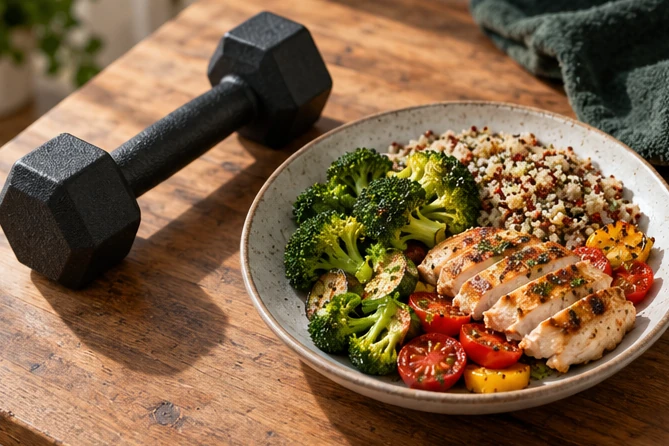
Keep lifting and eating adequate protein during fat loss. Choose a deficit you can recover from rather than treating the fastest scale drop as the best result.
Know what supports the takeaway.
- Key finding
- Keep lifting and eating adequate protein during fat loss. Choose a deficit you can recover from rather than treating the fastest scale drop as the best result.
- People, setting & outcomes
- Young men in a short controlled deficit with demanding exercise; results should not be generalized to every diet or ability level.
- Types of evidence
- Human or controlled experiments · Research synthesis. These labels describe sources, not a formal certainty grade.
- Limits
- The intensive research protocol is not a general prescription. Lean mass includes more than muscle, and individual protein and energy needs differ.
- Editorial source review
- · The Strong Table. No independent clinical reviewer or endorsement is claimed.
A lower body weight is not the whole goal for someone who wants to look and perform better. Muscle, strength and everyday energy deserve attention while fat decreases. That changes the priorities of a diet.
The plan should leave room for productive training and enough food to support a manageable routine. More restriction is not automatically more progress.
Protein and training work together
A controlled trial in young men combined a substantial energy deficit with intensive exercise. A higher-protein group achieved more favourable lean-mass and fat-mass changes than the lower-protein group. It shows what is possible under those specific conditions, not what everyone should copy.[1]
A broader protein-and-training meta-analysis also supports adequate protein for resistance-training adaptations. The practical message is to pair nutrition with a muscle-training stimulus, rather than expecting protein alone to preserve every aspect of performance.[2]
Keep the familiar lifts
Use exercises you can perform safely and compare over time. You may need to adjust total work as recovery changes, but replacing all lifting with calorie-burning circuits makes it harder to track strength. A training record provides more useful feedback than sweat alone.
A temporary performance dip does not prove muscle loss. Lower energy, fatigue and the day’s conditions can affect the session. Look at several weeks of performance, waist or clothing changes, and body-weight trends before deciding the plan has stopped working.
Build meals around repeatable protein choices
Include an appropriate protein food at your main meals: fish, eggs, dairy, tofu, legumes, poultry or other choices that fit your preferences. Portions, total intake and the rest of the diet matter more than declaring one food the only muscle-preserving option.
The calculator can estimate a starting target, but it cannot measure your true energy expenditure. Review the trend and how you feel. If training and ordinary life are becoming unmanageable, reducing the size of the deficit may be a better adjustment than another supplement.
Judge progress by more than speed
Set a realistic review interval and keep measurements consistent. Faster weight loss can be tempting, especially after a slow week, but water changes can distort short-term results. Avoid responding to every fluctuation with a further cut.
The useful outcome is a leaner body with a routine and performance you can maintain. If hunger, menstrual changes, recurrent injury or persistent fatigue appear, seek individualized help rather than pushing harder to protect an arbitrary deadline.
Read the evidence.
Follow the studies and official guidance. Numbered references identify the research behind the relevant discussion; practical suggestions and personal perspective are distinguished from study findings.
- Short randomized trial in young menLongland et al. (2016): protein, exercise and an energy deficit ↗
- Systematic review and meta-analysisMorton et al. (2018): protein and resistance-training adaptations ↗
General education for adults. Medical symptoms, prescribed diets and medication changes need individual guidance from a qualified healthcare professional.