Supplements / FROM THE EDITOR
Green tea extract: small benefits, a serious label check
EGCG, cholesterol, fat-loss claims and liver safety—what changes when a cup of tea becomes a concentrated capsule.
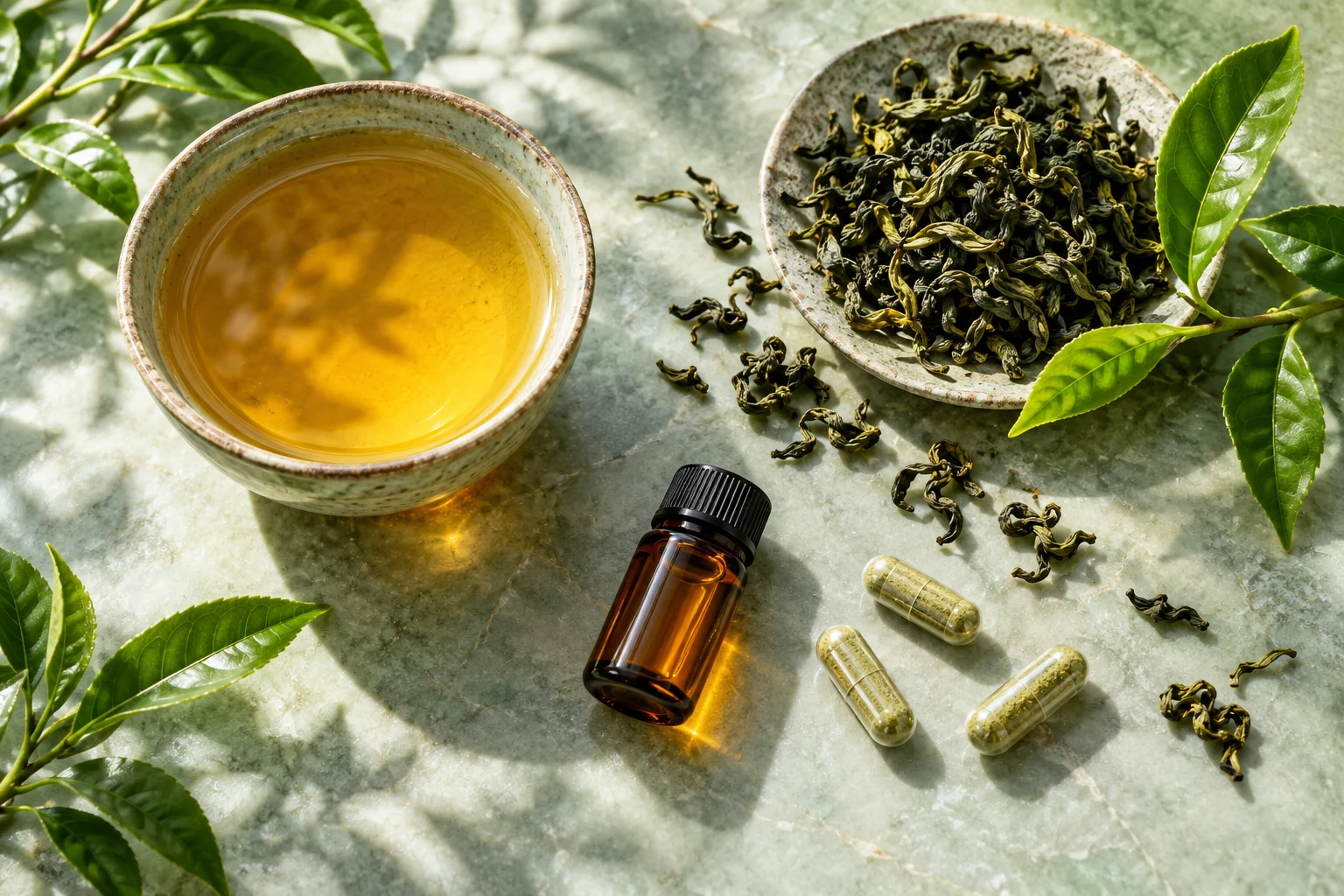
Green tea extract is a weak choice for meaningful fat loss. Small changes in cholesterol do not erase the liver risks of concentrated EGCG.
Know what supports the takeaway.
- Key finding
- Green tea extract is a weak choice for meaningful fat loss. Small changes in cholesterol do not erase the liver risks of concentrated EGCG.
- People, setting & outcomes
- Adults with overweight or obesity in weight-loss trials and supplement-safety evidence; formulations and liver risks vary.
- Types of evidence
- Research synthesis · Guidance, observational research or review. These labels describe sources, not a formal certainty grade.
- Limits
- Trials differ in formulation, caffeine content and population. Small changes in surrogate markers are not proof of disease prevention. No supplemental EGCG dose can be called universally safe from these data.
- Editorial source review
- · The Strong Table. No independent clinical reviewer or endorsement is claimed.
Green tea has a good reputation. Extract capsules borrow that reputation, then deliver a very different exposure. A relaxing drink and a concentrated dose of catechins are not interchangeable.
The useful question is not whether EGCG does something in a laboratory. It is whether the human benefit is large enough, reliable enough and relevant enough to justify taking it.
What is actually in the capsule?
Catechins are plant compounds; EGCG is one of the main catechins in green tea. Extracts vary in total catechins, EGCG and caffeine. A front label saying “500 mg green tea” does not tell you how much of any of those you are getting. Decaffeinated also does not mean free of extract-related liver concerns.[4]
The antioxidant explanation is biologically interesting, but an antioxidant assay is not a clinical outcome. Before treating a product as protective, look for trials measuring health, performance or symptoms—not just a change in a blood marker.
Benefits: separate the outcomes
These are the main claims worth evaluating. The weight and lipid findings come from controlled human studies; a disease-prevention promise needs a much higher standard than a small improvement in one risk marker.[1][2][4]
| Benefit or claim | What the evidence supports | Who it applies to |
|---|---|---|
| Body weight | Small or negligible average changes; not a dependable fat-loss tool | Adults with overweight/obesity studied in trials |
| LDL cholesterol | Modest average reduction in some pooled trials | Mixed adult populations; not a medication substitute |
| Alertness | May improve if the extract contains caffeine | Caffeine users; also brings stimulant effects |
| Cancer prevention | Not established by supplement trials | No general prevention recommendation |
| Muscle growth / recovery | No compelling established benefit | Healthy lifters should not expect added gains |
What the meta-analyses actually found
The Cochrane weight-management review found effects too small to be clinically important. Across six studies outside Japan, the average weight difference was about −0.04 kg, with the uncertainty interval including no benefit. Other study groups varied. That is a strong reason not to translate “increases fat oxidation” into “will make you lose body fat.”[1]
A 2020 meta-analysis of 31 trials found LDL cholesterol about 4.55 mg/dL lower, on average, and total cholesterol about 4.66 mg/dL lower. HDL and triglycerides did not show reliable improvements. These trials mixed drinks and preparations, so the result does not validate every extract sold online. A modest lipid effect also does not prove fewer heart attacks.[2]
The dose number that deserves your attention
EFSA identified increased liver enzymes in trials using supplemental EGCG at 800 mg/day or more. Importantly, it could not identify a reliably safe supplemental dose. Eight hundred is a warning signal, not a recommended dose, and taking less does not guarantee safety. There is no persuasive fat-loss rationale for chasing the highest concentration.[3]
Rare liver injury has been linked especially to concentrated products. If you take an extract, avoid taking it on an empty stomach and review it with a clinician if you have liver disease or use medicines. Stop and seek care for jaundice, dark urine or significant abdominal symptoms. Traditional tea usually produces a different pattern of exposure.[4]
How to read the label
Look for separate amounts of EGCG, total catechins and caffeine per daily serving. Check whether the serving means one capsule or several. If the label hides those amounts inside a blend, you cannot sensibly compare the exposure with research. Independent identity and contaminant testing is useful; it cannot turn an uncertain benefit into a proven one.
Also count caffeine from coffee and pre-workout products. An extract advertised as “natural metabolism support” may still be a stimulant. If you simply enjoy green tea, choose the drink for taste and routine rather than converting it into a high-dose supplement project.[4]
A better practical use for green tea
Unsweetened tea can be an enjoyable replacement for a sugary drink. The calorie difference comes from the swap, not a special fat-burning property. Try a tea you genuinely like, then keep the habits that move the result: an appropriate calorie intake, adequate protein and a training routine you can repeat.
If cholesterol is the priority, use your actual lipid results to guide decisions with your clinician. Do not judge success by feeling warmer, sweating more or seeing “antioxidant” on the bottle. The smartest supplement decision is sometimes to keep the pleasant drink and skip the capsule.
Read the evidence.
Follow the studies and official guidance. Numbered references identify the research behind the relevant discussion; practical suggestions and personal perspective are distinguished from study findings.
- Systematic review and meta-analysisCochrane: Green tea for weight loss and weight maintenance ↗
- Meta-analysis of 31 randomized trialsXu et al.: Green tea and blood lipids, 2020 ↗
- Scientific safety assessmentEFSA: Safety of green tea catechins, 2018 ↗
- Official evidence and safety summaryNCCIH: Green tea—usefulness and safety ↗
General education for adults. Medical symptoms, prescribed diets and medication changes need individual guidance from a qualified healthcare professional.