Nutrition / FROM THE EDITOR
Dietary fat and testosterone: read beyond the headline
Why very-low-fat diets deserve care, why the evidence is mixed, and why hormones cannot be managed with a single macro.
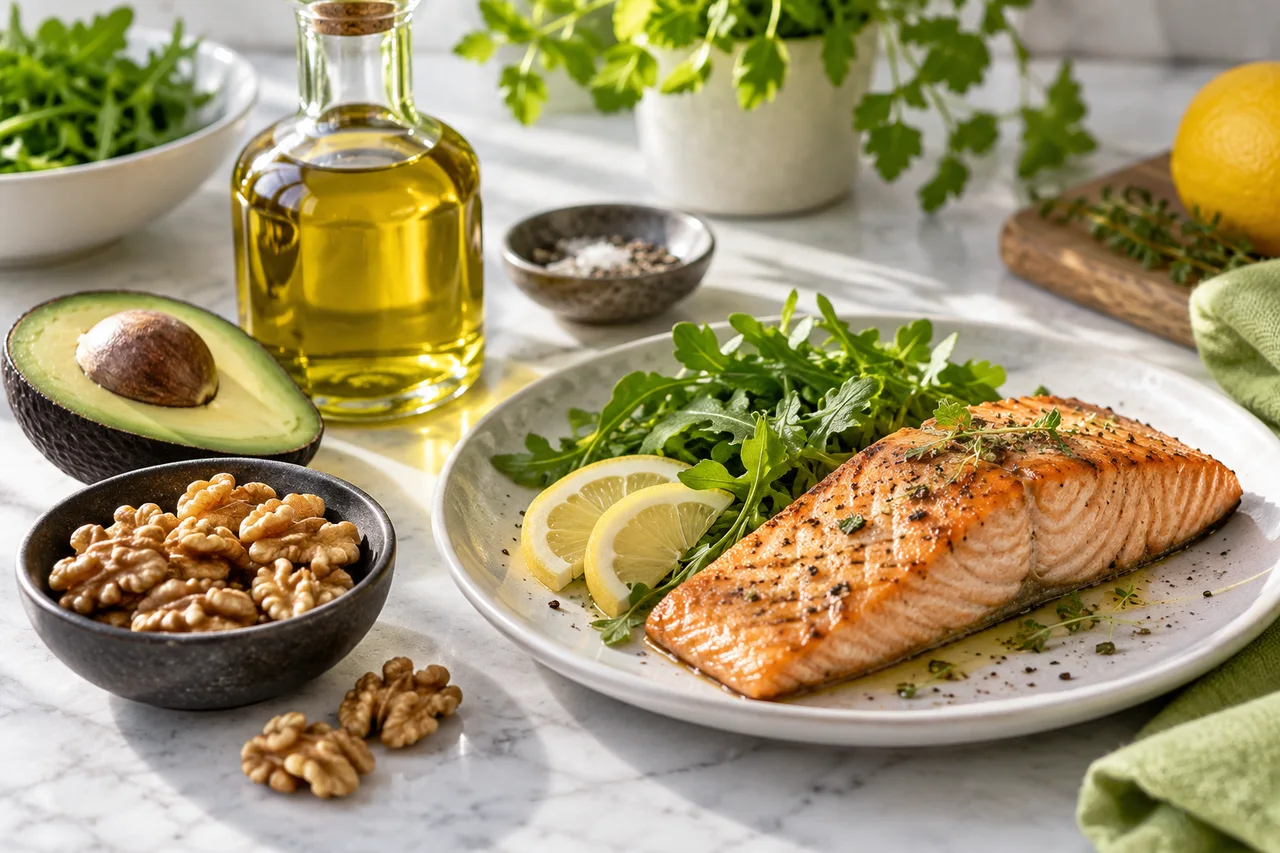
Do not remove dietary fat to chase faster fat loss. Do not assume eating more fat treats low testosterone. Overall energy, food quality and medical context matter.
Know what supports the takeaway.
- Key finding
- Do not remove dietary fat to chase faster fat loss. Do not assume eating more fat treats low testosterone. Overall energy, food quality and medical context matter.
- People, setting & outcomes
- Men in a small set of dietary intervention studies; hormone measurements are not direct muscle-growth outcomes.
- Types of evidence
- Research synthesis · Guidance, observational research or review. These labels describe sources, not a formal certainty grade.
- Limits
- Hormone studies have different populations and dietary protocols. The earlier review has a correction notice; neither pooled review establishes a dietary treatment for hypogonadism.
- Editorial source review
- · The Strong Table. No independent clinical reviewer or endorsement is claimed.
There is a tempting story here: testosterone is made from cholesterol, therefore more dietary fat must mean more testosterone. Biology is more regulated than that. A plausible mechanism is a starting point for research, not a completed nutrition prescription.
I would approach this topic with two priorities: keep an adequate, varied diet, and avoid treating symptoms or blood results with internet macro advice. The research is interesting precisely because it does not support one simple slogan.
What “low fat” means changes the comparison
A diet supplying 30% of calories from fat and a diet supplying 10% are both sometimes described as low fat, but they are very different interventions. Calorie intake, protein, fibre, fat types and weight change can differ too. To understand a study, ask what replaced the fat and whether total energy was comparable.
Fat provides essential fatty acids and helps absorb fat-soluble vitamins. That is a reason to include it, not proof that very high intake is hormonally superior. Olive oil, nuts, seeds, fish and other suitable foods can fit within a balanced pattern without pushing protein or carbohydrate out of the plan.
The widely cited 2021 finding
A 2021 review pooled six intervention studies involving 206 men and reported lower total and free testosterone on lower-fat diets. The authors called for more randomized trials. The publication record also lists a later corrigendum; it should not be presented as an unqualified final answer.[1][2]
Short studies and laboratory hormone differences do not automatically establish changes in symptoms, fertility, strength or muscle growth. A group average cannot predict one person’s response, and the amount of fat removed matters. I would not use this paper alone to prescribe a high-fat diet.
The newer review makes the uncertainty clearer
A 2025 meta-analysis included 11 randomized trials and 888 adults. It found no statistically significant overall difference in testosterone or other measured sex hormones between lower- and higher-fat diets. The authors also described the evidence as low certainty. Its broader population and study selection differ from the earlier men-only review.[3]
These reviews should be read together rather than choosing whichever conclusion supports a favourite diet. “No significant difference” does not prove the diets are identical under every circumstance. Equally, an earlier signal does not establish that ordinary lower-fat eating causes clinically low testosterone. The defensible conclusion is uncertainty about the size and practical importance of the effect.
Do not confuse low fat with low energy availability
A person can eat adequate fat and still be chronically underfuelled. Persistent restriction combined with substantial training can affect health and hormonal function. Another person may use a lower-fat pattern while obtaining enough total energy and nutrients. Those situations should not be treated as equivalent.
For an exercising adult, the commonly cited fat range of roughly 20–35% of total energy is a reasonable planning reference rather than a personalised treatment rule. At 2,000 calories that works out to about 44–78 grams because fat supplies approximately nine calories per gram. Special medical diets need individual guidance.[4]
What I would change in a real meal plan
Start by looking for extremes. Are you avoiding every yolk, sauce, nut and drop of oil? Are vegetables, fibre and carbohydrate being displaced by a “testosterone diet”? Neither pattern deserves automatic approval just because it has a compelling label.
- Include some unsaturated-fat foods across the week.
- Keep enough total food to support your activity and recovery.
- Set protein appropriately, then distribute carbohydrate and fat around preferences and training.
- Judge energy, hunger, performance and dietary variety together.
- Use a dietitian when medical restrictions or persistent symptoms make the plan more complex.
Symptoms need assessment, not a supplement stack
Low libido, fatigue or poor performance have many possible explanations. A testosterone diagnosis involves symptoms, appropriate laboratory testing and clinical interpretation; it cannot be made from your macro split. Sleep, medications, illness and body composition may also matter.
My practical position is to avoid unnecessarily extreme restriction while keeping the evidence in perspective. A balanced intake is sensible. Claiming that a certain fat percentage will “optimise hormones” for everyone is much stronger than the research allows. If symptoms persist, bring the whole picture to a qualified clinician rather than adding a booster or forcing a high-fat diet.
Read the evidence.
Follow the studies and official guidance. Numbered references identify the research behind the relevant discussion; practical suggestions and personal perspective are distinguished from study findings.
- Systematic review; later corrigendum listedWhittaker & Wu: Low-fat diets and testosterone, 2021 ↗
- Correction noticeCorrigendum to the 2021 review, published online 2025 ↗
- Meta-analysis; low-certainty evidenceSoltani et al.: Dietary fat and sex hormones, 2025 ↗
- Official evidence summaryNIH ODS: Exercise and athletic performance ↗
General education for adults. Medical symptoms, prescribed diets and medication changes need individual guidance from a qualified healthcare professional.