Training / FROM THE EDITOR
Progressive overload without turning every workout into a test
More weight is only one way forward. A simple training record makes progress clearer—and less frantic.
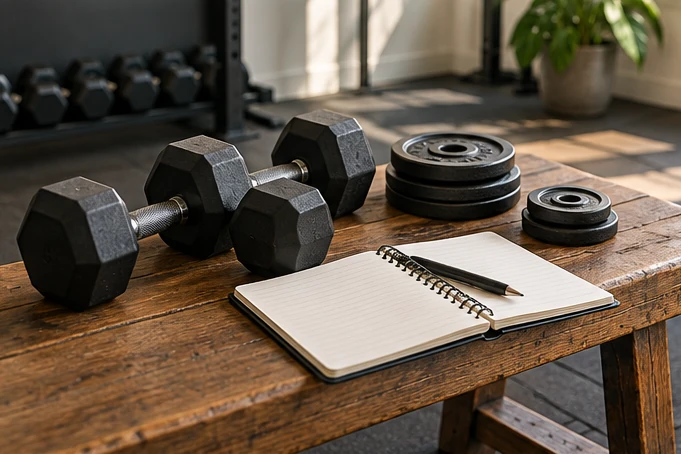
Repeat useful exercises, record controlled repetitions and increase the challenge when the current work becomes repeatable. Progress should improve training, not destroy technique.
Know what supports the takeaway.
- Key finding
- Repeat useful exercises, record controlled repetitions and increase the challenge when the current work becomes repeatable. Progress should improve training, not destroy technique.
- People, setting & outcomes
- Healthy adults across resistance-training reviews; findings do not prescribe one branded program or one progression speed.
- Types of evidence
- Research synthesis. These labels describe sources, not a formal certainty grade.
- Limits
- This progression example is a practical starting framework. Injury, sport-specific goals and advanced competition training may require individualized programming.
- Editorial source review
- · The Strong Table. No independent clinical reviewer or endorsement is claimed.
Progressive overload can sound like a rule that you must beat last week every time you enter the gym. That interpretation turns normal tired days into failures and encourages heavier weights before you are ready.
The better question is whether your training becomes appropriately more demanding over time. A notebook and a familiar routine usually answer it better than a different set of exercises every Monday.
What the science supports
ACSM’s updated guidance emphasizes regular resistance training and adapting the prescription to the goal. Complex periodization and particular equipment are not requirements for the average healthy adult. A manageable program performed consistently has more value than a sophisticated plan you rarely complete.[1]
Progression can involve resistance, repetitions, sets or improving the quality and range of a movement. These are not identical adaptations, and adding everything at once makes it hard to know what helped. Pick a measure that matches the exercise and your goal.
Use a repetition range
For an example, choose three sets in an 8–12 repetition range. Record the weight, each set’s repetitions and how many more controlled repetitions you think were available. When the top of the range is repeatable at the intended effort, try a small resistance increase.
The numbers are an illustration, not a universal prescription. With the new weight, repetitions may return toward the lower end of the range. That is expected. Avoid treating a faster, shorter or less controlled repetition as equal to the one you performed last week.
Keep conditions similar enough to compare
Use the same exercise variation, a similar range of motion and reasonable rest periods. A different machine, stance or tempo changes the task. You can still use variations, but label them clearly instead of comparing two unlike performances and concluding that strength has vanished.
Look for a pattern across several sessions. Sleep, stress and the order of exercises can affect one day’s result. If technique is stable and the longer trend improves, there is no need to force a personal best while fatigue is unusually high.
When the answer is less work
If several lifts decline, soreness stays high and motivation drops, first review recovery and the amount of work. A short reduction in training demand can be a sensible coaching choice. Adding more sets is not automatically the solution to a stalled set of results.
Change one variable, note why and give it enough time to evaluate. That approach turns overload into a feedback process. You are building capacity over months, not auditioning for a record every workout.
Read the evidence.
Follow the studies and official guidance. Numbered references identify the research behind the relevant discussion; practical suggestions and personal perspective are distinguished from study findings.
- Professional guidance based on an overview of reviewsACSM (2026): updated resistance-training guidance ↗
General education for adults. Medical symptoms, prescribed diets and medication changes need individual guidance from a qualified healthcare professional.