Supplements / FROM THE EDITOR
Whey concentrate or isolate: does the difference matter?
Protein targets, lactose, calories and amino-acid quality—the reasons to choose a powder without paying for a muscle-building myth.
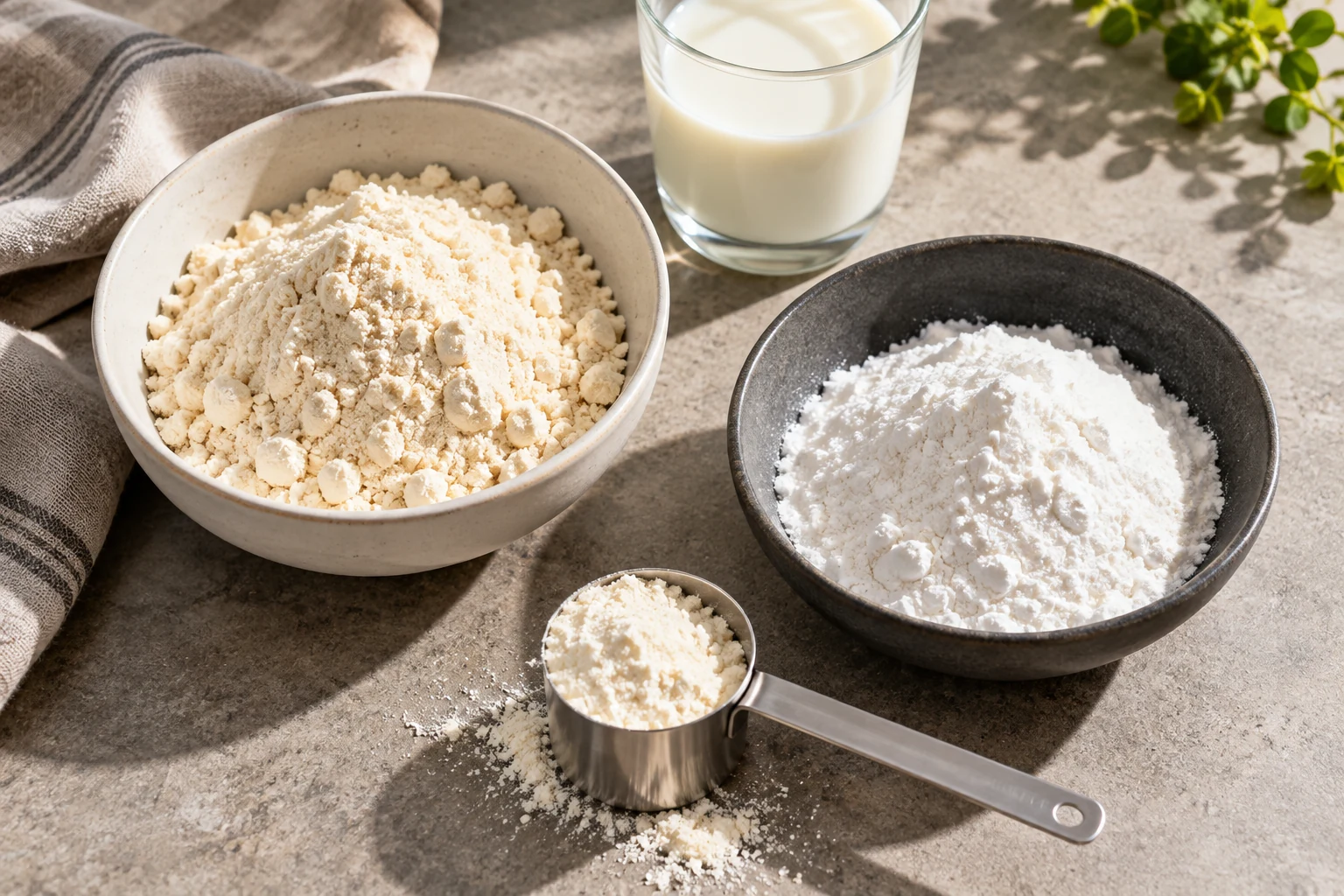
When usable protein intake is matched, isolate has no established automatic muscle-building advantage over concentrate. Choose by digestion, composition and convenience.
Know what supports the takeaway.
- Key finding
- When usable protein intake is matched, isolate has no established automatic muscle-building advantage over concentrate. Choose by digestion, composition and convenience.
- People, setting & outcomes
- Adult protein and resistance-training research; studies of daily protein targets do not prove all powders suit every digestive need.
- Types of evidence
- Guidance, observational research or review · Research synthesis. These labels describe sources, not a formal certainty grade.
- Limits
- The protein meta-analyses are not definitive direct concentrate-versus-isolate trials. The choice is a practical inference from protein quality, composition and broader training evidence. Medical protein restrictions need individualized advice.
- Editorial source review
- · The Strong Table. No independent clinical reviewer or endorsement is claimed.
Both whey concentrate and whey isolate come from milk. Isolate goes through additional processing to remove more non-protein material. The real decision is usually about what you tolerate and how the serving fits your day.
Your muscles do not recognize a premium label. They respond to training, enough amino acids and the food intake that supports the goal.
What changes—and what stays useful
Whey is a complete protein, meaning it supplies all nine essential amino acids. Both forms contain leucine and can help you meet a protein target. Concentrate generally retains more lactose, carbohydrate and fat; isolate generally delivers more protein per gram of powder. Exact values vary, so compare actual nutrition labels rather than product names.[1]
| Benefit or claim | What the evidence supports | Who it applies to |
|---|---|---|
| Concentrate | Complete protein; usually more lactose and non-protein material | Good option if you tolerate it |
| Isolate | Complete protein; usually less lactose, fat and carbohydrate | Useful when tolerance or serving composition matters |
| Muscle gain | No established automatic isolate advantage at matched usable protein | Daily intake and training are the main context |
| Fat loss | Neither directly burns body fat | Calories and protein still count |
| Milk allergy | Both contain milk proteins | Neither is an appropriate workaround |
The meta-analysis: daily intake earns priority
Morton and colleagues pooled 49 resistance-training studies with 1,863 participants. Protein supplementation modestly improved muscle and strength gains overall. Their analysis estimated a plateau for extra fat-free-mass benefit at about 1.6 g/kg/day of total protein, with a wide confidence interval extending to about 2.2 g/kg/day.[2]
That number is a group estimate, not a hard ceiling for every lifter. It also is not a head-to-head proof that every powder is identical. Its practical lesson is that adding expensive protein on top of an already sufficient intake is unlikely to transform your results. Count food and shakes together.
Does protein source really not matter?
Source matters less when total intake, essential amino acids and digestibility are sufficient—but it does not disappear. A 2018 meta-analysis found no clear difference between soy and animal-protein supplementation for training-related muscle and strength gains. That supports flexibility; it does not prove that every source works identically at every dose.[3]
Whey, soy, eggs, dairy, fish, meat and well-planned plant combinations can all contribute. If you rely heavily on a lower-leucine or less digestible source, serving size and variety may need more attention. Collagen is not equivalent to whey as the main muscle-building protein because its essential-amino-acid profile is different.[1]
Choose a serving that solves a real gap
Sports nutrition guidance commonly places most exercising adults around 1.4–2.0 g/kg/day, with needs influenced by the person and goal. For an illustrative 75 kg adult, that is 105–150 g across the whole day. A powder is useful if meals leave a gap; it is optional when your food already covers it.[4]
Compare grams of protein per serving, not scoop size. A 30 g scoop of one product may contain less protein than a 30 g scoop of another. Then compare calories, ingredients and how it tastes. A product you comfortably use when needed is more valuable than a theoretically “purer” powder you avoid.
When isolate is worth considering
If lactose causes symptoms, a low-lactose isolate may be easier to tolerate. It is not automatically lactose-free: check the label and your response. Milk-protein allergy is a separate issue, and both forms can trigger it. For allergy, use an appropriate non-milk option with professional guidance.[1]
Isolate may also fit when you need a little more protein with fewer accompanying calories. Those differences are often small relative to your full day. During fat loss, compare the complete serving—including milk, nut butter or other additions—before assigning the result to concentrate versus isolate.
Buying and using it well
Prefer transparent protein amounts, clear allergen information and independent quality checks. Competitive athletes should look for verified sport-specific testing, which reduces contamination risk but does not prove a performance advantage. Avoid judging the product by amino-acid buzzwords alone.[4]
Use the powder to make an ordinary routine easier: a shake after a rushed session, protein stirred into breakfast or a convenient snack. You do not need to panic about a narrow post-workout window. Start with the daily target, spread sensible protein servings across meals, and choose the form your budget and digestion support.
Read the evidence.
Follow the studies and official guidance. Numbered references identify the research behind the relevant discussion; practical suggestions and personal perspective are distinguished from study findings.
- Official evidence summaryNIH ODS: Protein and sports supplement evidence ↗
- Meta-analysis of 49 studiesMorton et al.: Protein and resistance training, 2018 ↗
- Meta-analysisMessina et al.: Soy versus animal protein, 2018 ↗
- Sports nutrition position standISSN: Protein and exercise, 2017 ↗
General education for adults. Medical symptoms, prescribed diets and medication changes need individual guidance from a qualified healthcare professional.